
Department of
Computer Science
Fostering academic excellence, advanced research, and holistic development to shape the innovators of tomorrow.
Overview
Vision
To impart quality, academic, and research-oriented undergraduate education that prepares students for the dynamic landscape of technology.
Mission & Legacy
The Department of Computer Science at mLAC began its journey in 1987 with a Pre-University (PUC) course, followed by the introduction of the B.Sc. in Computer Science in 1989. The department holds the unique distinction of being headed by Mrs. Sudha Murty (Chairperson, Infosys Foundation) from its inception until 1996.
Recognizing the need of the hour, the Bachelor of Computer Applications (BCA) degree was introduced in 2000. Both the B.Sc. (Physics, Mathematics, Computer Science) and BCA programs proudly received academic autonomy in 2016.
Leadership Timeline:
- 1987 – 1996: Mrs. Sudha Murty
- 1996 – 2015: Dr. Rama M. A.
- 2000 – 2015 (BCA): Prof. Chitra Ravi
- 2021 – Present: Ft. Lt. Harish H.
Department Highlights
- Research & Innovation: Faculty and students are actively engaged in research through various Department of Biotechnology (DBT) funded projects.
- State-of-the-Art Infrastructure: Equipped with high-speed Ethernet, wireless networks, and advanced computing labs.
- Skill Enhancement: We offer UGC-sponsored, job-oriented add-on Certificate and Diploma courses, alongside regular workshops, industrial visits, and alumni interactions.
- Holistic Development: A robust academia-industry interface ensures excellent career support, while students are encouraged to participate in co-curricular activities to groom their overall personalities.
Course Outcomes: Bachelor of Computer Applications (BCA)
Semester I
- Problem Solving Techniques Using C & Lab: Master structured/modular programming, algorithms, flowcharts, dynamic memory allocation, and file management in C.
- Computer Organization & Architecture & Lab: Understand logic gates, Boolean Algebra, combinational/sequential circuits, processor structures, and memory organization.
- Mathematical Foundations for Computer Applications: Gain knowledge in set theory, matrices, permutations, graph theory, and analytical geometry.
Semester II
- Data Structures & Lab: Design and analyze time/space efficiency for linear arrays, linked lists, stacks, queues, trees, and graphs, alongside searching and sorting algorithms.
- Database Management Systems (DBMS) & Lab: Master ER modeling, normalization, transaction processing, and concurrency control. Practical application of DDL, DML, and nested SQL queries.
- Numerical & Statistical Methods: Learn floating-point representations, root-finding methods, interpolation, probability distribution (Binomial, Poisson, Normal), and regression.
Semester III
- Object-Oriented Programming Using Java & Lab: Understand OOP paradigms, inheritance, multithreading, exception handling, and GUI creation using AWT and Applets.
- Operating System & Linux & Lab: Explore process synchronization, memory/disk management, deadlock avoidance, and develop programming skills using Linux shell scripting.
- Design and Analysis of Algorithms: Solve complex problems using Divide & Conquer, Greedy methods (Dijkstra’s), Dynamic Programming, and Backtracking.
Semester IV
- Microprocessor & Assembly Language & Lab: Deep dive into the 8085 microprocessor architecture, instruction formats, memory interfacing, and assembly language programming via simulators.
- Web Programming & Lab: Build dynamic, interactive websites using HTML/XHTML, CSS, JavaScript (DOM, Event handling), and XML.
- Software Engineering: Learn industry-standard software process models, user interface design, reliability metrics, software testing, and cost estimation.
Semester V
- Data Communication & Networks: Understand the OSI and TCP/IP models, switching, multiplexing, error correction, IP addressing, and application layer protocols (DNS, HTTP).
- Computer Architecture: Advanced study of CPU organization, RISC/CISC architecture, cache/virtual memory, and parallel processing systems (Amdahl’s law, multi-core).
- Python Programming & Lab: Master Python data structures (lists, tuples, dictionaries), regular expressions, GUI, data visualization, and database connectivity.
- Data Warehousing and Data Mining & Lab: Implement data pre-processing, OLAP, association analysis, clustering, and classification algorithms.
- Minor Project (PRJ-5): Conduct literature surveys, design system architectures, implement software technologies, and generate a comprehensive Software Requirement Specification (SRS).
Semester VI
- System Programming: Design assemblers and macro processors, and understand loader schemes, binders, and the phases of compiler design.
- Data Analytics & Lab: Leverage R programming for descriptive/predictive analytics, hypothesis testing, machine learning (KNN, Naïve Bayes, Decision Trees), and understand Big Data/Hadoop ecosystems (HDFS, MapReduce).
- Major Project (PRJ-6): An advanced, capstone software development project encompassing full-lifecycle system design, coding, validation, and documentation.
Academic Programs
Bachelor of Science - Physics, Mathematics, Computer Science (PMC)
Bachelor Of Computer Applications (BCA)
Department Updates
View All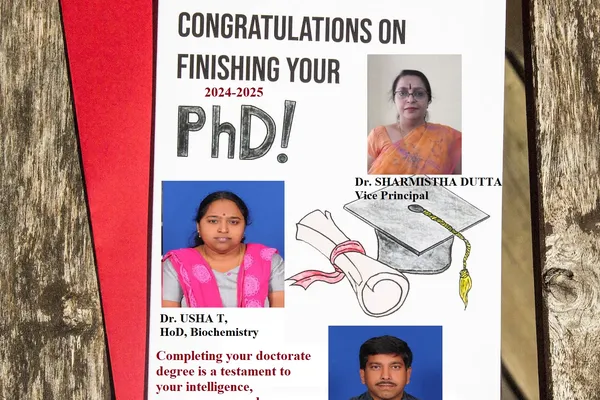
Faculty Directory
View All
Mrs Shambbavi S
Head of the Department
information system,Software Engineering, Computer Science Artificial Intelligence
View Profile →



On This Page
Contact Information
- info@mlacw.edu.in
- +91 80 2334 1535
-
Maharani Lakshmi Ammanni College for Women
Malleshwaram, Bengaluru 560012